Once a simple tool to reduce manual contact in public restrooms, the sensor urinal has evolved into a multi-functional device integrating water efficiency, hygiene protection, and smart management. Its development over half a century, driven by brand innovations, reflects the upgrading demands for public health and environmental sustainability. Here’s its journey through key eras and application scenarios.
- Pioneering Era (1970s–1980s): Birth of Touchless Flushing
Post-war public health concerns and water scarcity issues spurred the invention of touchless flushing technology. U.S.-based Sloan Valve Company, a pioneer in plumbing fixtures, launched the first prototype sensor urinal in the late 1970s. Adopting basic infrared sensing, it triggered flushing when detecting user departure, solving the problem of cross-contamination from manual handles and reducing water waste from forgotten flushes.
Japan’s TOTO followed in the 1980s with proximity-detector-based models, optimizing the sensor response time to 0.5 seconds. These early devices, though bulky and reliant on AC power, became staples in airports and hospitals—cutting water usage by 30% compared to manual flushers, but struggling with false activations from strong light.
- Refinement Era (1990s–2000s): Reliability & Water Efficiency
Electronics miniaturization and material advancement addressed early flaws, expanding sensor urinals to more public spaces. American Standard revolutionized the segment in the 1990s with adjustable flush volume technology: 1.2 liters for light use and 3 liters for heavy use, adapting to traffic peaks in malls and offices.
By the 2000s, European brand Duravit introduced concealed sensor modules, blending functionality with minimalist bathroom design for luxury hotels.
- Smart Integration Era (2010s–2020s): Hygiene & Intelligence Upgrade
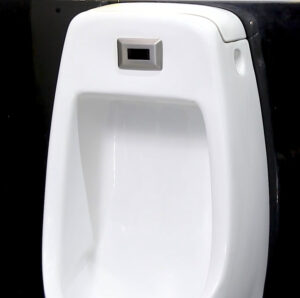
The 2020 pandemic accelerated demand for advanced hygiene features, pushing sensor urinals toward multi-functional integration. China’s JOMOO launched smart models in 2018 with dual-sensor systems: infrared for presence detection and microwave radar for anti-interference, boosting detection accuracy to 97%.
JOMOO took water efficiency further in 2025 with its water-saving urinal, achieving a mere 1.5-liter per flush while meeting national first-level water efficiency standards—down from the traditional 6–9 liters, translating to annual savings of 150,000 liters per unit. It also added antibacterial glaze (99.9% antibacterial rate) and 24-hour automatic sterilization, becoming a choice for public restroom upgrades in cities like Zhongwei.
U.S. brand Zurn introduced cloud-connected models in 2023, enabling facility managers to monitor usage frequency and water consumption remotely, and receive leak alerts—reducing maintenance response time by 60% in stadiums and airports.
- Application Scenarios: From Public to Private Spaces
Public Infrastructure
Airports and transportation hubs prioritize durability and water efficiency. Beijing Daxing International Airport uses Sloan’s solar-powered sensor urinals, which harvest kinetic energy from water flow to power sensors, eliminating battery waste. Urban public restrooms, like those in city Zhongwei,adopt JOMOO models with anti-splash design and deodorant traps, enhancing user experience in high-traffic areas.
Commercial Venues
Luxury hotels and office buildings combine functionality with aesthetics. Duravit’s concealed-sensor urinals are featured in five-star hotels, while chain cafes use JOMOO water-saving models to cut operational costs by 25% through optimized water usage.
Residential & Special Spaces
High-end residences now embrace compact sensor urinals. Japan’s Panasonic launched wall-mounted smart models in 2024 with night-light activation and low-noise flushing. For senior care facilities, LIXIL developed wide-range sensors that detect wheelchairs, providing accessibility for users with mobility impairments.
Future: Health Monitoring & Circular Economy
Upcoming innovations focus on health management and sustainability. Stanford University’s prototype integrates urine analysis modules, using sensors to track biomarkers like glucose and protein, with data synced to health apps. Brands like ORAS are testing 100% recycled stainless steel bodies with biodegradable sensor casings, aligning with the EU Circular Economy Action Plan.
Conclusion
From Sloan’s basic infrared prototype to JOMOO smart water-saving models, sensor urinals have evolved from simple flushing tools to comprehensive hygiene solutions. As IoT and health tech advance, they will play a more vital role in public health protection, water conservation, and smart facility management—redefining the standard for modern restroom fixtures.
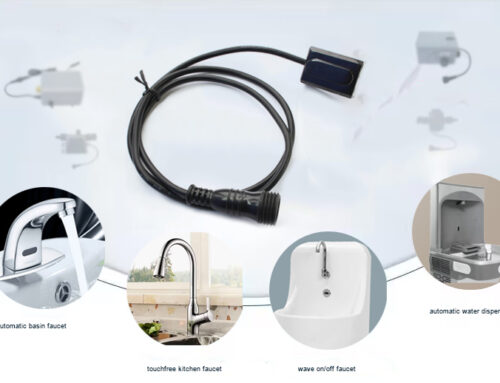
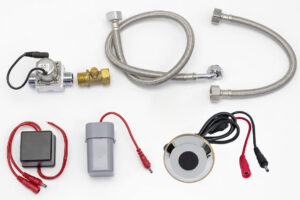
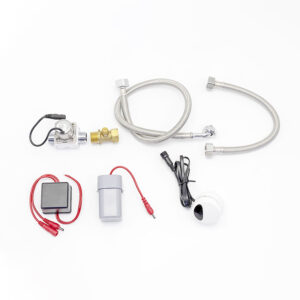
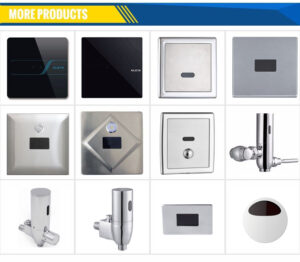
RAJEY Electronics primarily manufactures infrared sensors, sensor faucets, sensor urinal flush valves, and sensor toilet flush valves. We also provide direct or indirect sensor kits for some of the aforementioned brands and others not mentioned. Please feel free to contact us if you have any interest in or needs regarding our sensor products.